
"Friendly and professional" tells your AI almost nothing about your brand
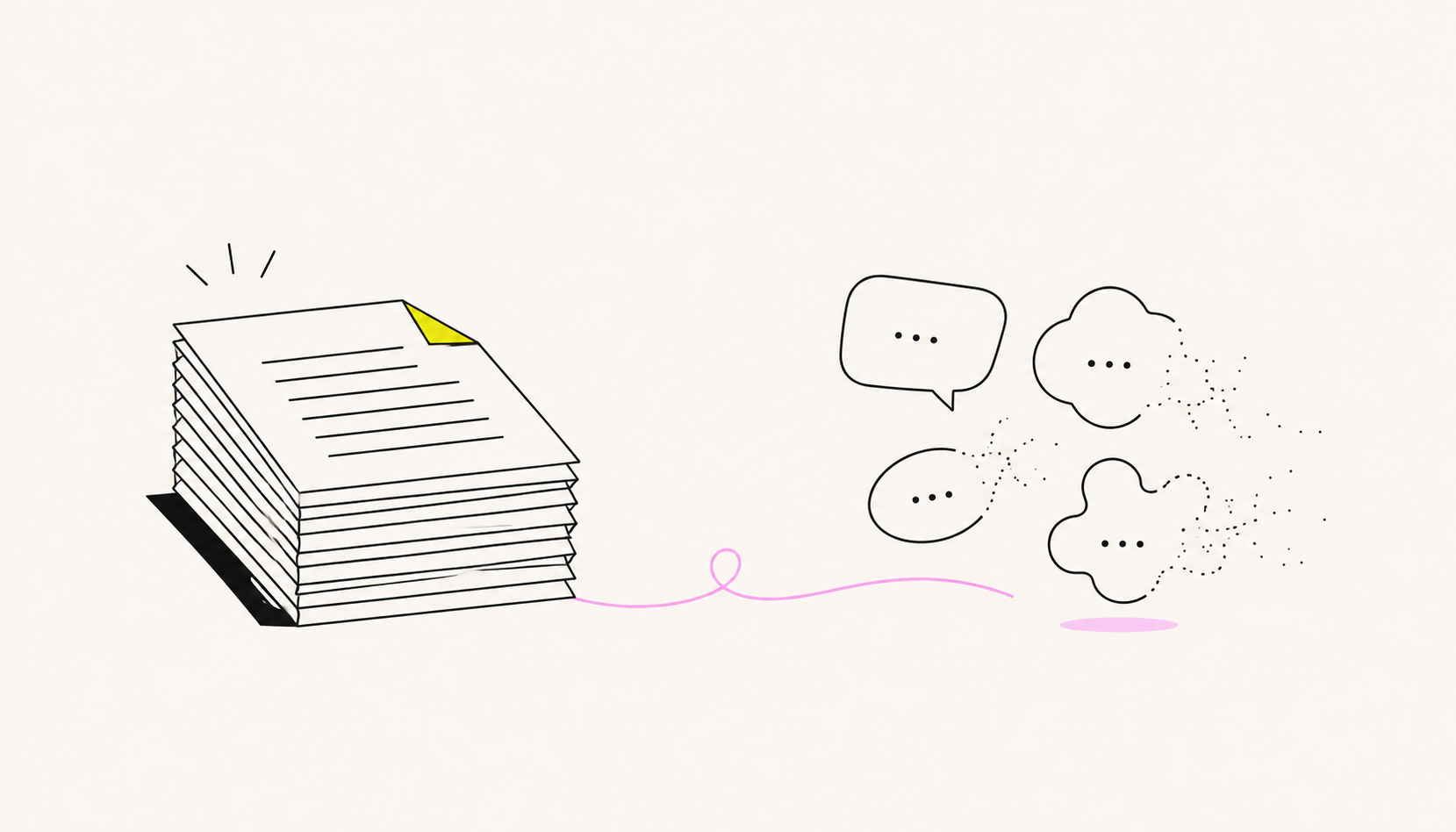
Reliable, on-brand AI output comes from two things working together: guardrails and examples. Guardrails are the rules, limits and required disclaimers baked in around the model, so it stays inside the lines. Examples are a corpus of real, gold-standard passages that show the model how your brand actually writes. Guardrails keep the output safe; examples make it sound like you. A human still signs off before anything ships.
Key takeaways
- Guardrails are hard rules and limits around a model. Examples are real passages that teach it your patterns.
- A language model predicts the next word from patterns, so real writing moves it far more than adjectives do.
- Adjectives like "confident, warm, plain" barely constrain word choice. Ten real passages give the model your voice.
- Guardrails handle safety, compliance and required disclaimers. Examples handle tone and phrasing.
- Together they raise the floor on quality, so even an average prompt produces usable, on-brand work.
- Neither replaces human review. A person signs off before anything reaches a customer.
What are AI guardrails?
AI guardrails are the rules and limits set around a model to keep its output safe, compliant and inside agreed boundaries. They cover things the model must never do, phrases it must always include, and topics it must refuse or escalate. Think of them as the fence, not the map.
In a business setting, guardrails often include required disclaimers, banned claims, and a rule that legal or medical content gets a human check. They also cover data handling, such as never pasting client information into a consumer tool.
Guardrails matter because a model is confident even when it's wrong. As the Chief Justice of NSW put it in the 2026 Harold Ford Memorial Lecture, AI "produces output with great confidence and clarity of language, features which it has in common with the most accomplished of fraudsters" (Chief Justice Andrew Bell, 2026). Guardrails are how you catch that confidence before it reaches a customer. They also line up with formal guidance: the Australian Voluntary AI Safety Standard sets out ten guardrails for organisations using AI, including meaningful human oversight, data governance and record-keeping (Australian Government, Voluntary AI Safety Standard, 2024).
| Guardrail type | What it does | Example |
|---|---|---|
| Hard rules | Blocks output that breaks a policy | Never state a price without a source |
| Required inclusions | Forces content to appear every time | Add the finance disclaimer to advice |
| Escalation triggers | Routes sensitive work to a person | Legal wording goes to human review |
| Data limits | Controls what the model can see or use | No client data in consumer tools |
Why do examples beat adjectives for brand voice?
Examples beat adjectives because a language model predicts the next word from patterns, and real passages give it your actual patterns. When you write "confident, warm, plain", the model has to guess what those words mean for your brand. That guess lands somewhere generic, because millions of brands describe themselves the same way.
Real writing removes the guessing. Ten genuine passages from your best emails, posts or pages show the model your sentence length, your rhythm, the words you reach for and the ones you avoid. It stops predicting a generic "warm" and starts predicting your warm.
This is why a list of adjectives barely moves the output while a small corpus moves it a lot. The adjectives describe the destination. The examples show the road. Building brand voice examples for AI is the single most valuable step for reliable AI output.
It helps to picture what the model is doing under the bonnet. A model predicts the next token, a word or part of a word, from the patterns it has seen. Language models place words in a high-dimensional "meaning space", where related words sit close together and meaning is captured by position (Mikolov et al., 2013). Every brand lives in a particular region of that space: the vocabulary and register it reaches for, and the words it never uses.
A corpus of real examples points the model at your slice of that meaning space. It teaches the model which words and phrases your brand actually reaches for and which it avoids, so it draws from your neighbourhood of meaning rather than the average of everyone else's. This is the job examples do that adjectives can't: an adjective names a mood, but a passage shows the model exactly where in meaning space your brand sits. Paired with guardrails, that combination gives you output that is both safe and unmistakably yours.
| Input to the model | What it gives the model | Effect on output |
|---|---|---|
| Adjectives ("confident, warm") | A vague target | Small, generic |
| A "we say / we don't say" list | Clear word-level rules | Moderate |
| Ten real passages | Your actual patterns | Large, specific |
Most teams skip this step because their brand knowledge is scattered. MIT NANDA found that about 95% of enterprise generative AI pilots deliver no measurable P&L impact, largely because the tools lack context: they don't retain feedback or adapt to how a team actually works (MIT NANDA, The GenAI Divide, 2025). When everyone works from a different personal login, there's no shared corpus for the model to learn from, so every output drifts a different way.
How do guardrails and examples work together?
Guardrails and examples do two different jobs, and you need both. Guardrails set the boundaries: what's allowed, what's required, what gets escalated. Examples set the voice: how the words actually sound. One keeps you safe, the other keeps you recognisable.
Picture a report drafted by AI. Guardrails ensure it never invents a statistic and always flags legal content for review. Examples ensure it reads like your team wrote it, not like a generic template.
Together they raise the floor. Even an average prompt produces work that's safe and on-brand, because the boundaries and the voice are already built in. That's the difference between AI you have to rewrite and AI you can trust.
There's a useful order to it. Guardrails come first, because a fast off-brand draft is annoying but a fast non-compliant one is a real problem. Examples come next, because once the output is safe you want it to sound like you. Get both in place and the model does more of the work you'd actually put your name to.
MIT NANDA found that the pilots that stall do so because the tools don't retain feedback, don't adapt to workflows and don't improve over time, not because the technology can't do the job (MIT NANDA, The GenAI Divide, 2025). Guardrails and a real corpus are how you fix that context problem, which is the side that usually breaks.
Where do guardrails and examples live?
Guardrails and examples live in a governed context layer that sits underneath your AI, not in one person's chat history. A context layer is a single source of truth for your brand, product and process, so every tool and every person works from the same rules and the same examples.
Utilaa calls this Context Intelligence. It holds your guardrails and your corpus of gold-standard passages in one governed place. Built once, reused everywhere, and improved over time.
The alternative is fragmentation: each person keeps their own prompts and examples in a personal login, so the quality depends on who's asking. When someone leaves, their guardrails and their best examples leave with them. The business is back to a blank page.
A shared context layer fixes that. The guardrails and the corpus stay with the business, so a new starter inherits the same standards on day one. It also compounds. Every good passage you add and every rule you refine makes the next output a little better for everyone.
A governed layer also makes the formal guardrails practical. The Australian Voluntary AI Safety Standard calls for data governance, record-keeping and accountability across an organisation's AI use (Australian Government, Voluntary AI Safety Standard, 2024). A shared context layer is where those obligations actually live, because the setup outlives any single project or person.
When should a human still review AI output?
A human should review AI output before it reaches a customer, a regulator or the public, every time. Guardrails and examples raise the quality of the first draft, but they don't remove the need for judgement. They make the review faster and rarer, not optional.
The higher the stakes, the more the review matters. Legal, financial and medical content should always get a person, and often a qualified one. AI supports that review; it doesn't replace it.
Guardrails and examples get you a reliable, on-brand starting point. A person then applies judgement the model doesn't have. As the Chief Justice noted, internal controls and guardrails give organisations "visibility mechanisms" over AI use (Chief Justice Andrew Bell, 2026). The human sign-off is the last and most important control.
Frequently asked questions
What's the difference between guardrails and examples?
Guardrails are hard rules and limits that keep AI output safe and compliant, such as required disclaimers or escalation triggers. Examples are real, gold-standard passages that teach the model how your brand actually writes. Guardrails control what the model must and mustn't do. Examples control how it sounds.
How many examples does an AI model need to learn a brand voice?
You don't need thousands. A small set of ten to twenty genuinely representative passages usually shifts output far more than any list of adjectives. Quality and relevance matter more than volume. Pick your best, most on-brand writing, not just your most recent.
Can't I just describe my brand voice in a prompt?
You can, but describing it with adjectives barely constrains the output. A model predicts the next word from patterns, so "friendly and professional" leaves it guessing. Real passages give it your patterns directly, which is why examples produce far more consistent, on-brand results.
Do guardrails slow AI down?
Not meaningfully. Guardrails run alongside the model and shape its output rather than blocking it. The small cost of a required check is far lower than the cost of publishing an unsafe or off-brand claim. Good guardrails save time by cutting rework.
Are AI guardrails the same as content moderation?
They overlap but aren't identical. Moderation usually filters harmful content after it's generated. Business guardrails are broader, covering brand rules, required disclaimers, data limits and escalation triggers baked in around the model. Moderation is one type of guardrail, not the whole picture.
Does using guardrails and examples remove the need for human review?
No. They raise the quality of the first draft and make review faster, but a person still signs off before anything ships. For legal, financial or medical content, that review should involve a qualified human. AI supports the reviewer; it doesn't replace them.
If you'd like to see what guardrails and a real brand corpus look like for your business, book a call.
A note on legal matters: this article is general in nature and conversational in tone. It isn't legal advice. Before you implement AI in your business, involve your own security and legal teams and get advice suited to your situation.

Latest insights and trends



Ready to use AI well?